Quantum Computing: The Technology Reshaping Our Future
What is Quantum Computing and its real-world impact.
BLOG
Pushkaraj Sant
11/4/20253 min read
Imagine a computer so powerful it could solve in minutes what would take today's supercomputers thousands of years. This isn't science fiction—it's quantum computing, and it's already beginning to transform our world.
What Is Quantum Computing?
At its core, quantum computing represents a fundamental shift in how we process information. While traditional computers use bits that exist as either 0 or 1, quantum computers use quantum bits, or "qubits," that can exist in multiple states simultaneously thanks to a phenomenon called superposition.
Think of it this way: if a classical bit is like a coin that's either heads or tails, a qubit is like a coin spinning in the air—it's both heads and tails at once until you observe it. This property, combined with quantum entanglement (where qubits become interconnected and influence each other instantaneously), allows quantum computers to process vast amounts of possibilities in parallel.
The Quantum Advantage
The power of quantum computing lies in its ability to tackle problems that are practically impossible for classical computers. While your laptop processes information sequentially, quantum computers can explore millions of potential solutions simultaneously. This makes them particularly suited for:
Complex Optimization Problems: From routing delivery trucks efficiently to optimizing financial portfolios, quantum computers excel at finding the best solution among countless possibilities.
Molecular Simulation: Understanding how molecules interact is crucial for drug discovery and materials science, but it requires simulating quantum mechanical systems—something quantum computers are naturally built to do.
Cryptography: Quantum computers could potentially break many of today's encryption methods, but they're also enabling the development of quantum-safe cryptography to protect our data in the future.
Real-World Impact Today
Quantum computing is already moving from laboratories into practical applications:
Healthcare and Drug Discovery: Pharmaceutical companies are using quantum computers to simulate molecular interactions, potentially reducing the time and cost of developing new medications. This could accelerate treatments for diseases like Alzheimer's, cancer, and rare genetic disorders.
Climate Modeling: Scientists are exploring quantum computing to create more accurate climate models, helping us understand and address climate change with unprecedented precision.
Financial Services: Banks and investment firms are testing quantum algorithms for risk analysis, fraud detection, and portfolio optimization, potentially saving billions while making markets more stable.
Artificial Intelligence: Quantum computing could supercharge machine learning algorithms, enabling AI systems to process and learn from data in ways we're only beginning to understand.
Materials Science: Researchers are using quantum computers to design new materials—from more efficient batteries to superconductors that work at higher temperatures, potentially revolutionizing energy storage and transmission.
The Challenges Ahead
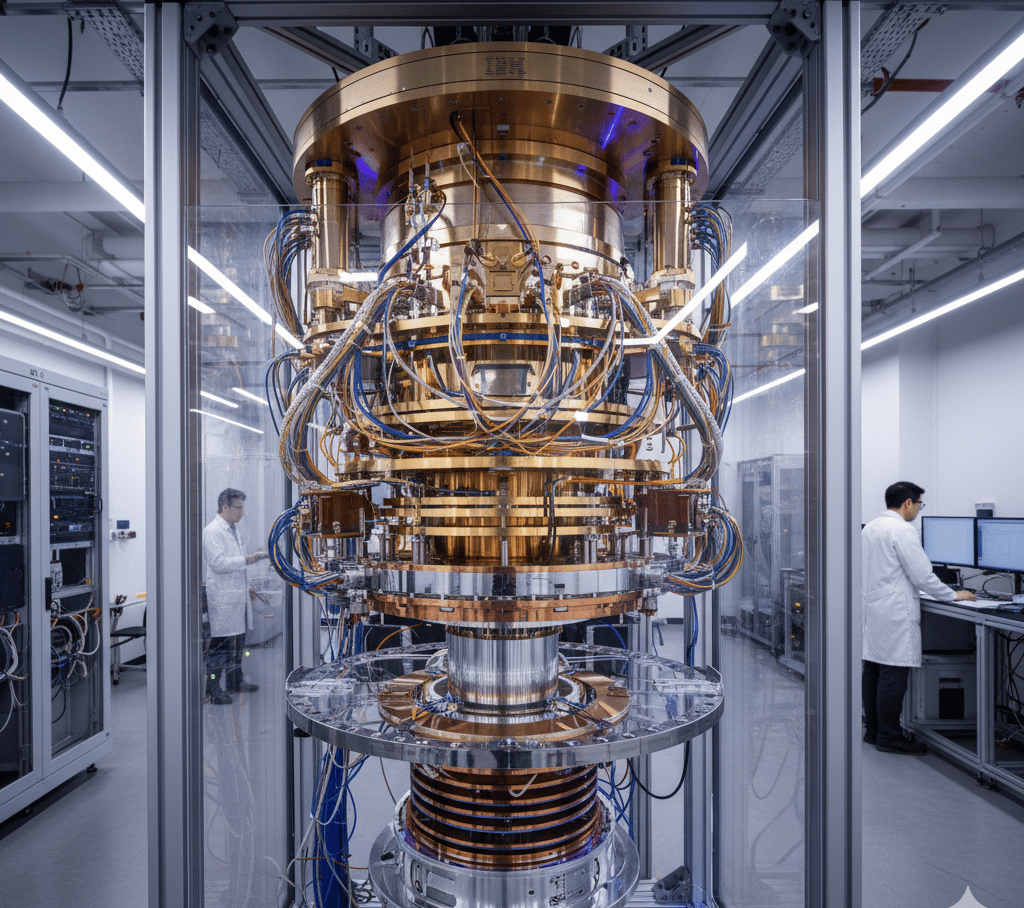
Despite the excitement, quantum computing faces significant hurdles. Qubits are incredibly fragile and require extreme conditions to operate—often temperatures near absolute zero. Even tiny vibrations or electromagnetic interference can cause errors. Current quantum computers are still relatively small, with the most advanced systems containing only hundreds of qubits, and they require sophisticated error correction.
There's also a talent gap. Quantum computing demands expertise at the intersection of physics, computer science, and mathematics—skills that are in short supply. Companies and universities worldwide are racing to train the next generation of quantum engineers.
A Quantum Future
We're currently in what experts call the "Noisy Intermediate-Scale Quantum" (NISQ) era—quantum computers exist and work, but they're not yet powerful or reliable enough to revolutionize every industry. However, progress is accelerating. Tech giants like IBM, Google, and Microsoft are investing billions in quantum research, while startups are developing specialized quantum applications.
Within the next decade, we may see quantum computers tackle problems that shape our daily lives: discovering breakthrough medications, optimizing traffic in smart cities, creating unbreakable communication networks, and advancing artificial intelligence beyond current limitations.
The Bottom Line
Quantum computing represents more than just faster processing—it's a fundamentally different way of approaching problems. While it won't replace your laptop anytime soon (classical computers will remain superior for most everyday tasks), quantum computing is opening doors to solutions we couldn't previously imagine.
As this technology matures, it promises to accelerate scientific discovery, strengthen global security, and help address some of humanity's greatest challenges. We're witnessing the early days of a computing revolution that will reshape industries, economies, and our understanding of what's computationally possible.
The quantum age is just beginning, and its impact on our world will be nothing short of extraordinary.